
Gina’s Journey: From refugee to a pillar of strength as a CNA.
A Leap Toward Independence
Gina describes herself as having grown up a “spoiled and introverted child.” The youngest of five sisters, she was surrounded by love and protection. Her eldest sister felt more like a second mother. Another sister guided her life choices, while others helped shoulder her challenges and looked after her well-being—even now, her youngest sister in New York checks in often to make sure she’s okay.
“I never lived apart from my parents,” Gina shared. “I was always surrounded by family. I didn’t know how to make decisions on my own.”
Coming to the U.S. changed that. With her family’s support, Gina made the biggest decision of her life: to leave home and step into the unknown, determined to grow into a stronger, more independent version of herself.
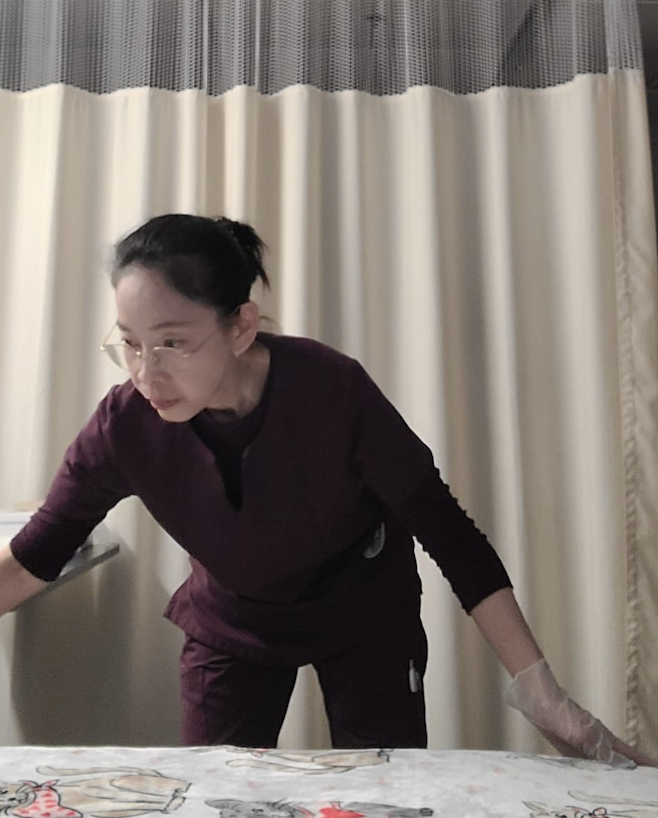
Gina in the nursing facility
From Office to Elder Care: Why Gina Became a CNA
Gina’s decision to become a CNA was deeply personal. Before coming to the U.S., she worked in an administrative role in her home country. Like many immigrants, she discovered that her professional background didn’t translate into opportunity in the US. The shift from office work to hands-on elder care was a major transition, but it was driven by purpose.
For Gina, becoming a CNA wasn’t just about finding a job. It was about self-growth. “I chose this path,” she said, “to improve myself, to become a more knowledgeable person, and to live a happy life. And to me, a happy life means using my skills to help people who depend on others, so they can enjoy life a little more easily.”
That sense of purpose became even more personal after the passing of her father, who had been diagnosed with prostate cancer at a late stage. Witnessing his decline from strength to helplessness left a lasting impact. She remembered not just his physical pain, but the emotional vulnerability that came with losing independence. That experience inspired her to step into a role where she could offer more than just assistance—she wanted to give patients both strength and heart, ensuring that those who feel helpless still feel seen, loved, and supported.
Learning to Adapt
Gina enrolled in the CNA program with determination, even though the demanding schedule made it nearly impossible for her to take on a job. As an immigrant, the financial pressure was intense, but she never gave up. With unwavering emotional and financial support from her mother and sisters, she pushed forward.
Gina had no prior medical background, but thanks to the patience and clarity of her instructors, the material became more approachable. When she failed her first quiz, she didn’t lose heart. Instead, she doubled down, reviewing materials, watching instructional videos, and dedicating herself to improvement. Her persistence paid off. She passed both the written and skills exams on her first try and proudly earned her CNA certification.
A Rough Start in the Real World of Care
Stepping into the real world of long-term care was far more challenging than she had imagined. In her first few weeks, Gina was assigned to care for a high number of dependent residents. The environment was high-pressure and emotionally intense. She felt constantly watched, and sometimes unfairly criticized. When she needed help, her coworkers weren’t always available. Despite being new, Gina did her best to support others, often taking on extra tasks and helping her peers. But over time, the physical strain and emotional weight began to wear her down.
“There were moments I really wanted to give up,” she shared. “It was so different from CNA school, where I had encouragement. At work, it felt like I was always under a microscope.”
What helped Gina through this difficult period was the unwavering support from Dr. Esther and her husband at Accesso Care. When Gina admitted she was thinking about quitting, they didn’t push her away. Instead, they reminded her of her purpose and her potential.
“They told me I was the right person to be a caregiver,” Gina said. “That other people’s opinions didn’t matter as much as the love and attention I gave to my residents.”
With that encouragement, Gina shifted her mindset. She stopped focusing on the judgments around her and started pouring her energy into the people who mattered most—her residents.

Gina graduated from the school
Choosing Compassion and Love
Gina began spending more time talking to residents, learning their stories, and understanding their needs. She worked hard to build trust and create a sense of comfort for those in her care. Slowly, the atmosphere began to change.
“When I walked into a room and heard, ‘Hey, Gina’s here—my favorite!’—that’s when I knew I was doing something right,” she said.
She also learned to navigate the challenges of cultural and language differences. Each resident came from a unique background, and connecting with them took empathy, listening, and patience. But for Gina, the emotional connection made every effort worth it.
“Once I started focusing only on the residents, everything else faded away,” she said. “I stopped letting people’s opinions affect me. I just did my work, and found it meaningful.”
Now in her second month as a CNA, Gina is still learning—but she has found her rhythm and a deep sense of purpose.
Her advice to other new CNAs?
“Focus on your own job and don’t let emotions lead you. Care with your whole heart, and the rewards will come.”
There Are Many Ginas Out There
Gina is not alone. Her story mirrors that of countless immigrants who arrive in the U.S. with hope, resilience, and often, impressive professional backgrounds. Many—like Gina—held stable careers or advanced degrees in their home countries. But upon arriving in the U.S., they are faced with the stark reality of downward occupational mobility: taking on physically demanding, lower-paying jobs that many Americans less prefer, simply to survive and rebuild. Becoming a CNA is often one of the few viable entry points into the U.S. labor market, despite requiring emotional labor and long hours.
Today, over 25% of the nation’s 1.4 million CNAs are immigrants, many of whom are women of color navigating a complex healthcare system while managing language, cultural, and financial barriers. Their work forms the backbone of elder care in long-term care facilities—yet they are routinely underpaid, undervalued, and under-supported. The median wage for CNAs remains around $17 per hour, and turnover rates in some states exceed 50%, with many leaving within their first year due to burnout and lack of proper guidance.
Gina’s journey reflects a broader issue in the nursing industry—one that places immense pressure on those doing the most intimate and emotional work. Yet her resilience offers a roadmap: with trust, cultural understanding, and a strong support system, immigrant CNAs can not only survive, but thrive.
How Accesso Care Supports Immigrant CNAs Like Gina
At Accesso Care, we understand the unique challenges that immigrant CNAs face—from navigating unfamiliar healthcare systems to overcoming language and cultural barriers. That’s why we go beyond job placement.
We provide comprehensive support throughout the entire CNA journey, including help with certification, language-accessible training, emotional mentorship, and ongoing check-ins after job placement. Our staff—including Dr. Esther and her team—stay personally involved, offering encouragement, guidance, and advocacy when challenges arise.
We believe that immigrants like Gina deserve more than just a job—they need long-term, ongoing support throughout their journey. That’s why Accesso Care is here.

Gina with other CNAs
