
Breaking Barriers: Addressing the real-world challenges facing healthcare workers today.
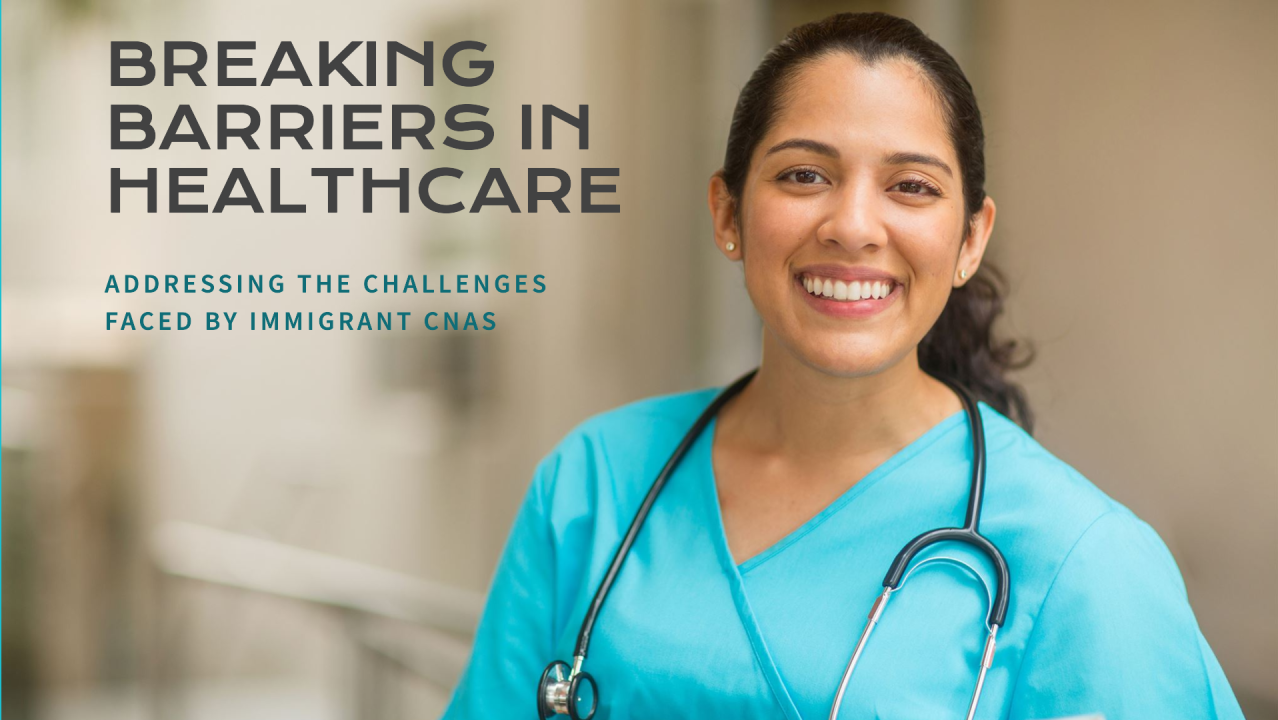
Breaking Barriers: Addressing the Challenges Facing Immigrant CNAs to Strengthen Our Healthcare System
The Growing CNA Shortage and the Role of Immigrant Workers
Certified Nursing Assistants (CNAs) are integral to resident-centered care in skilled nursing facilities (SNFs), assisted living communities, and home health settings. These professionals provide over 80% of hands-on direct care in long-term care environments, supporting 1.2 million residents with essential activities of daily living, including bathing, dressing, feeding, and mobility.
Yet, despite their critical role, the United States is facing a severe CNA shortage. A recent study projects a shortfall of approximately up to 100,000 CNAs by 2028, further straining the healthcare system. Immigrants constitute approximately a quarter of the CNA workforce, which can help fill the gap.
However, despite their clinical competencies and commitment to patient care, many face barriers that delay workforce entry, directly impacting staffing compliance, reimbursement models, and quality ratings in long-term care facilities. To sustain quality outcomes and operational efficiency, we must proactively address these workforce bottlenecks and advocate for strategic policy reforms that enable CNAs—including immigrants—to obtain timely certification and employment.
Exam Barriers
Immigrant CNAs often face significant challenges on their certification exams. While these candidates may have extensive caregiving experience and strong clinical skills, the complexity of medical terminology, nuanced exam phrasing, and lack of translated resources can create unnecessary obstacles. Many CNA exams rely heavily on written instructions and multiple-choice questions, which can be difficult for non-native English speakers, even if they are otherwise competent in patient care. These language barriers can result in lower pass rates, forcing immigrant CNAs to retake exams multiple times, leading to significant financial burdens from additional exam fees and preparation costs, as well as emotional stress from prolonged uncertainty, frustration, and potential delays in securing employment.
The CNA certification exam in the U.S. is mainly offered in English and Spanish. Some states provide additional languages. Currently, Pennsylvania does not offer the CNA exam in languages other than English. This limitation can pose significant challenges for non-native English speakers.
Financial Barriers
The cost of CNA training in Philadelphia is a significant challenge for many, especially low-income immigrants. Training programs range from $1,450 to $1,845. Beyond tuition, students must also cover textbooks and certification exam fees, which cost $135 in Pennsylvania. These expenses make CNA certification financially challenging for many aspiring nursing assistants, particularly those earning low wages or supporting families.
Administrative Barriers
Securing employment in nursing facilities can be particularly challenging for immigrant CNAs due to administrative barriers. The entire process is lengthy. In Pennsylvania, CNAs must complete a state-approved training program that includes at least 80 hours of classroom and clinical instruction. This process typically takes anywhere from one to six months to complete.
After completing training, candidates in Pennsylvania must pass the Pennsylvania Nurse Aide Competency Exam, which includes both a written test and a skills evaluation. Additionally, they must undergo two background checks: a Pennsylvania State Police Criminal History Record Check and, if they have lived in Pennsylvania for less than two consecutive years, an FBI fingerprint-based background check. They also need to undergo a medical and physical examination, including a PPD test to confirm they are tuberculosis-free. These requirements ensure that CNAs meet both competency and safety standards before working in nursing facilities.
Besides, the availability of testing opportunities is limited. For instance, the skills evaluation is only offered at designated test centers, and candidates are permitted only three attempts to pass both the clinical skills and written competency evaluation tests within two years after completing their nurse aide training program. If unsuccessful, they are required to complete a new training program to be eligible to test again. These cumulative challenges not only delay entry into the workforce but also discourage many qualified individuals from pursuing CNA roles, therefore exacerbating staffing shortages in nursing facilities.
How Accesso Care is Breaking Barriers
At Accesso Care, we are committed to helping immigrants overcome these challenges and enter the CNA workforce successfully. We aim to collaborate with policymakers and leading nursing facilities in Philadelphia to achieve these goals effectively. Our approach includes:
✅ Fast-Track Training & Certification: Accesso Care partners with a local school to offer a five-week CNA training program, significantly reducing the time required for certification. By streamlining the process, we help more immigrants enter the workforce faster and fill critical staffing shortages.
✅ Financial Assistance & Support: We provide tuition reimbursement, fully funded from our own resources. We also advocate for more funding, scholarships, and grants to ease the financial burden of CNA training. Expanding tuition assistance programs ensures that low-income immigrant CNAs can access certification without economic hardship.
✅ Improving Exam Accessibility: We work with government officials and policymakers to push for more testing locations, flexible scheduling, and expanded language support to make certification exams more accessible. We want to ensure that qualified candidates can successfully navigate the certification process and join the workforce.
Call to Action
The long-term care sector cannot afford to ignore the critical workforce crisis affecting CNA availability. Nursing home administrators and industry leaders must take proactive steps to address barriers to certification and employment.
Key Next Steps for Administrators and Policymakers:
✔ Advocate for state and federal policies streamlining CNA training and certification pathways.
✔ Partner with organizations like Accesso Care to implement fast-track training models.
✔ Utilize tuition reimbursement and workforce incentives to retain new CNAs.
✔ Support initiatives to expand exam accessibility and reduce regulatory friction.
A stable, well-trained CNA workforce is not just a compliance requirement—it is the foundation of quality resident care, operational efficiency, and long-term sustainability for skilled nursing facilities.
➡️ Join us in advocating for these changes! What steps do you think are most urgent? Let’s discuss this in the comments.
